Getting stronger legs and glutes after 40 does not have to mean spending hours in the gym or pushing through workouts that leave you barely able to walk the next day.
When I started paying more attention to lower body strength, I realized that consistency mattered much more than doing complicated exercises or lifting the heaviest weights possible.
For many women over 40, the goal is not simply to make the legs look toned. It is also about feeling stronger when climbing stairs, getting up from a chair, carrying groceries, playing with the kids, or getting through a busy day without feeling completely drained.
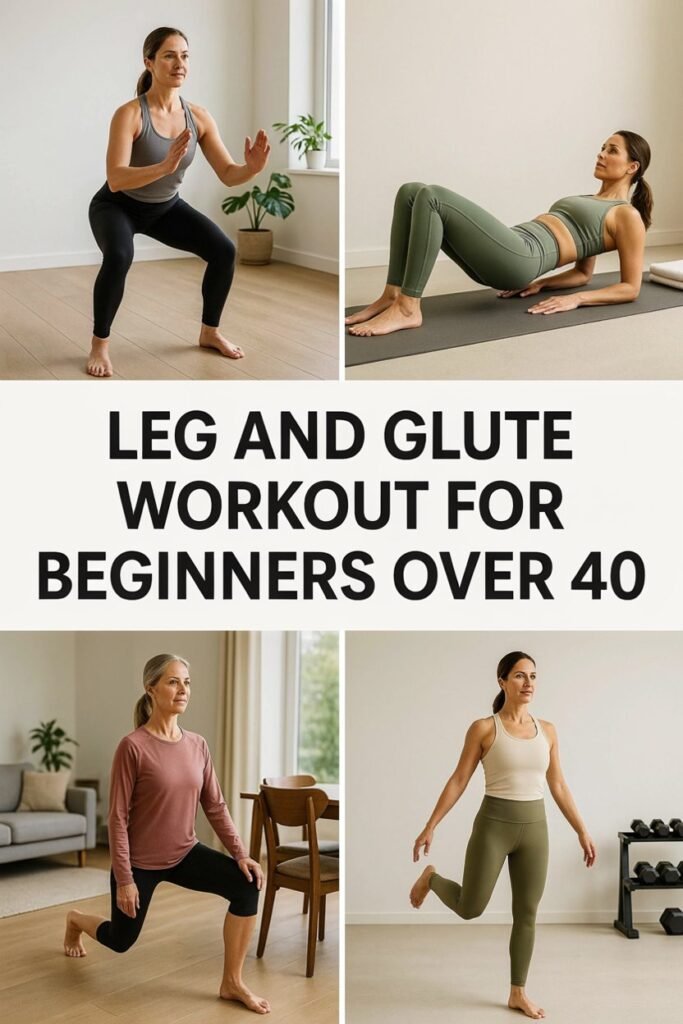
A good beginner leg and glute workout should help with those everyday movements while gradually building strength and confidence.
I also learned that the body needs a little more patience as we get older. Warming up properly, using controlled movements, choosing manageable resistance, and allowing enough recovery can make a huge difference. You do not need to punish your body to see progress.
This beginner workout focuses on simple exercises that target the glutes, thighs, hamstrings, and calves without making the routine unnecessarily complicated. You can do it at home with little or no equipment, making it much easier to fit into a normal week.
Why Leg and Glute Strength Matters After 40
Lower body strength becomes especially important as we get older because our legs support almost everything we do during the day.
Strong glutes can help you feel more stable when walking, climbing stairs, bending down, and standing up. Stronger thighs can make everyday movements feel easier, while stronger hamstrings and calves contribute to overall lower body stability.
I noticed that strength training became much more useful when I stopped thinking about it only as a way to change my appearance. Being able to move more comfortably and feel stronger during ordinary activities became just as important to me.
There is also something satisfying about noticing small improvements. Maybe you can perform a few more squats without stopping. Maybe walking uphill feels easier.
Maybe you can carry your shopping bags without feeling as tired. Those little changes are worth paying attention to because they show that your body is becoming stronger.
What Beginners Over 40 Should Know Before Starting
If you have not exercised consistently for a while, you do not need to jump straight into an intense lower body routine.
Start with movements you can perform comfortably and focus on learning good form. Your first goal should be becoming familiar with the exercises rather than trying to make every workout exhausting.
I prefer starting with bodyweight exercises because they make it easier to concentrate on movement. Once the exercises feel comfortable, you can gradually add resistance with dumbbells, resistance bands, or other equipment.
A little muscle soreness can happen when you introduce your body to new movements, but severe pain is not something you should try to work through. If you have an existing injury, joint problem, or medical concern, it is sensible to speak with a qualified healthcare professional before beginning a new exercise routine.
How Often Should You Train Your Legs and Glutes?
For beginners, two lower body workouts per week can be a very good starting point.
You do not need to train your legs every day to make progress. Your muscles need time to recover, especially when you are introducing resistance training after a long break.
I would rather complete two manageable workouts every week than start with five intense sessions and lose motivation after two weeks.
You can leave at least a day between lower body sessions. On the other days, you can focus on walking, upper body training, mobility work, or simply staying active through your normal daily routine.
The important thing is to build a routine that fits your actual life.
Start With a Short Warm Up
Before moving into the workout, spend about five minutes getting your body ready.
You can walk around your room, march gently in place, move your arms, perform slow bodyweight squats, and make controlled hip movements.
I have found that rushing straight into squats or lunges when the body feels stiff is not the best way to begin. A few minutes of gentle movement helps me feel more prepared and makes the workout feel smoother.
Keep the warm up easy. You are preparing your body for exercise, not trying to tire yourself out before the workout begins.
Beginner Leg and Glute Workout
For your first few sessions, aim for 2 sets of 8 to 12 repetitions for each exercise.
Rest for about 45 to 90 seconds between sets, depending on how you feel.
1. Bodyweight Squats


Bodyweight squats are one of the easiest exercises to build into a beginner lower body routine.
Stand with your feet around hip width apart. Keep your chest lifted and slowly bend your knees while pushing your hips back. Lower yourself only as far as feels comfortable, then press through your feet to return to standing.
Think about sitting back into a chair rather than simply dropping straight down.
When I was focusing on improving my own squat, slowing the movement down made a noticeable difference. I became much more aware of my legs and glutes working instead of rushing through each repetition.
If regular squats feel difficult, place a sturdy chair behind you and use it as a guide. You can lightly touch the chair before standing again.
2. Glute Bridges


Glute bridges are excellent when you want to focus more directly on the glutes without putting a lot of pressure on your knees.
Lie on your back with your knees bent and your feet flat on the floor. Keep your feet about hip width apart.
Press through your feet and lift your hips toward the ceiling. Squeeze your glutes gently at the top, then lower your hips with control.
The important part is not how high you can lift your hips. Focus on controlled movement and feeling the glutes doing the work.
When I perform glute bridges, I try not to rush the repetitions. Holding the top position briefly makes the exercise feel much more effective than simply moving up and down quickly.
3. Reverse Lunges


Reverse lunges can strengthen the glutes, thighs, and supporting muscles while also challenging your balance.
Start standing tall with your feet comfortable apart. Step one foot backward and slowly lower your body toward the floor. Push through the front foot to return to your starting position, then switch sides.
If your balance is not great, hold onto a wall or the back of a sturdy chair.
There is no reason to make this exercise harder than necessary when you are starting. I would rather take a shorter step and perform the movement with control than take a large step and struggle to maintain balance.
You can begin with 6 to 8 repetitions per side and gradually increase as you become more comfortable.
4. Standing Glute Kickbacks


Standing glute kickbacks are simple and require very little space.
Stand behind a sturdy chair or near a wall for support. Keep your torso relatively still while extending one leg backward. Squeeze your glute gently, then bring your leg forward without swinging it.
The temptation is to lift the leg as high as possible, but that is not necessary.
A smaller controlled movement is often much easier to perform correctly. Keep your hips facing forward and avoid twisting your body to get the leg higher.
Complete your repetitions on one side before switching.
5. Step Ups


Step ups are particularly useful because they resemble a movement we perform in everyday life.
Use a low, stable step or platform. Place one foot firmly on the surface and press through that foot to bring your body upward. Step down carefully and repeat before switching sides.
Start with a low step. There is no advantage to choosing a high platform that makes you feel unstable.
This exercise became one of my favorites because it feels practical. Stronger step ups can translate into feeling more confident when using stairs or stepping onto curbs.
If you feel uncomfortable or unstable, lower the height or leave this exercise out until your balance improves.
How to Make This Workout Easier
Beginners do not need to complete the hardest version of every exercise.
If squats are difficult, use a chair.
If reverse lunges feel unstable, hold onto a wall.
If step ups feel challenging, use a lower step.
If you struggle with the recommended number of repetitions, simply perform fewer and build gradually.
Your workout should challenge you without making you feel like you have failed because you cannot complete an advanced version.
The goal is to create a starting point that you can actually repeat next week.
What I Would Focus On First
If you are starting this type of workout after 40, I would focus on three things before worrying about heavier weights or advanced exercises.
Good form
Learn how each movement should feel and keep your repetitions controlled.
Consistency
Give yourself enough time to establish the habit before constantly changing your routine.
Progress
When the workout begins to feel noticeably easier, increase repetitions slightly, add another set, or introduce a small amount of resistance.
You do not need to make all three changes at once.
The best workout is usually the one you can perform consistently while still recovering well enough to come back and do it again.
6. Romanian Deadlift With Dumbbells


Once bodyweight exercises begin to feel comfortable, a Romanian deadlift is a useful exercise to add because it targets the hamstrings and glutes while teaching an important hip movement.
Stand with your feet about hip width apart while holding a light dumbbell in each hand. Keep your back neutral, soften your knees, and slowly push your hips backward. Allow the dumbbells to travel down the front of your legs while keeping them close to your body.
You do not need to lower the weights all the way to the floor.
Stop when you feel a comfortable stretch through the backs of your legs, then push your feet into the floor and squeeze your glutes as you return to standing.
This is one exercise where slowing down makes a big difference. I used to think the main goal was getting the dumbbells lower, but the movement became much more useful when I concentrated on pushing my hips backward instead.
Start with very light weights until the movement feels natural.
Aim for 8 to 10 controlled repetitions for 2 sets.
7. Sumo Squats


Sumo squats give you another way to work the lower body while placing a little more emphasis on the inner thighs and glutes.
Stand with your feet wider than shoulder width and turn your toes slightly outward. Keep your chest lifted as you bend your knees and lower your hips. Press through your feet to return to standing.
Your knees should generally track in the same direction as your toes rather than collapsing inward.
You can perform this exercise using only your bodyweight. Once it becomes easier, hold one light dumbbell with both hands in front of your body.
I like using sumo squats as a variation rather than trying to perform the exact same squat every workout. It keeps the routine interesting while still giving the lower body plenty of work.
Start with 8 to 12 repetitions.
8. Supported Split Squats


Split squats can be challenging for beginners, but using support makes them much more approachable.
Stand in a staggered position with one foot slightly in front of the other. Hold onto a sturdy chair or wall if you need help with balance.
Slowly bend both knees and lower your body. Keep most of your attention on maintaining a stable position rather than trying to go extremely low.
Push through the front foot to return to the starting position.
You can begin with only 6 to 8 repetitions on each side.
I would not rush into adding weights here. Balance and control are more important than resistance when you are learning the movement.
If this exercise causes discomfort in your knees, reduce your range of motion or choose another lower body exercise that feels more comfortable.
9. Calf Raises


Your calves deserve attention too, especially because they contribute to walking, balance, and everyday lower body movement.
Stand behind a sturdy chair or near a wall. Slowly raise your heels so you are standing on the balls of your feet. Pause briefly at the top, then lower your heels with control.
Avoid bouncing through the movement.
I find that calf raises are easy to underestimate because they look simple. Once you slow the exercise down and pause at the top, you can feel the muscles working much more clearly.
Start with 12 to 15 repetitions.
As your strength improves, you can perform them on one leg or hold light weights, but there is no need to rush toward the harder versions.
10. Glute Bridge March


If regular glute bridges have become comfortable, you can make them slightly more challenging with a glute bridge march.
Begin in the same position as a regular glute bridge. Lift your hips and hold them steady. While keeping your hips as level as possible, slowly lift one foot a few inches from the floor. Place it down and repeat on the opposite side.
The biggest challenge is preventing your hips from rocking from side to side.
You do not need to lift your foot very high. Small, controlled movements are enough.
Start with 6 to 8 alternating repetitions per side.
If you cannot keep your hips stable, return to regular glute bridges until your strength improves.
A Simple Beginner Workout Routine
You do not need to perform every exercise in one session.
For a beginner workout, I would start with the following combination:
- Bodyweight squats
- Glute bridges
- Reverse lunges
- Romanian deadlifts
- Standing glute kickbacks
- Calf raises
Perform 2 sets of each exercise.
For most movements, aim for 8 to 12 repetitions. For calf raises, you can work toward 12 to 15 repetitions.
Rest when you need to.
If you are completely new to strength training, even one set of each exercise can be enough during your first week.
Your first few workouts are about learning how your body responds.
How Long Should a Leg and Glute Workout Last?
A beginner session does not need to take an hour.
Around 25 to 35 minutes can be enough when you include your warm up, exercises, rest periods, and a short cool down.
This is one reason I like home workouts. I do not have to spend extra time driving to a gym, waiting for equipment, or trying to fit a long workout into an already busy day.
If you have only 20 minutes available, use the time you have.
A short workout that you actually complete is more valuable than a perfect one that keeps getting postponed.
How to Progress Without Overdoing It
Progress does not always mean adding heavier dumbbells.
There are several ways to make a workout gradually more challenging.
You can add a few repetitions.
You can add another set.
You can slow down the lowering portion of an exercise.
You can pause briefly when the muscle is working hardest.
You can move from bodyweight to light resistance.
You can use a slightly heavier dumbbell when your current weight becomes comfortable.
For example, if you can comfortably perform 12 bodyweight squats for two sets and feel like you could easily continue, you might add a third set or introduce a light dumbbell.
I prefer making small changes rather than suddenly doubling the amount of weight. This gives me a much better idea of how my body is responding.
What About Resistance Bands?
Resistance bands can be useful if you want to add variety without buying a full set of weights.
A band can be used around the thighs for exercises such as glute bridges, lateral movements, and squats.
However, you do not need resistance bands to begin.
If you are just starting out, bodyweight movements are enough to teach you the basic patterns. Equipment should make your routine more useful, not make it more complicated.
How Many Days a Week Should You Exercise?
A simple weekly schedule could look like this:
Monday
Leg and glute workout
Tuesday
Walking or light activity
Wednesday
Rest or gentle mobility work
Thursday
Leg and glute workout
Friday
Walking or another form of enjoyable activity
Saturday
Optional light activity
Sunday
Rest
You can change these days around based on your schedule.
The important thing is giving your lower body enough recovery between strength sessions.
If your legs are still extremely tired from your previous workout, there is no prize for forcing yourself through another hard session.
Do You Need Cardio Too?
Strength training and cardio can work very well together.
Walking is an especially simple option for beginners. You can start with a comfortable amount and gradually increase your time or distance.
You do not have to spend an hour running on a treadmill to support your fitness goals.
A regular walk, combined with strength training and a generally active lifestyle, can be a much more realistic routine for many women over 40.
I also find that walking gives me a nice mental break. It does not feel like another demanding workout, but it still gets me moving and helps me avoid spending the entire day sitting.
How to Know If the Workout Is Working
Do not judge your progress only by what you see in the mirror.
Pay attention to how the exercises feel.
Maybe you can perform more repetitions.
Maybe you need less support during lunges.
Maybe your squats feel smoother.
Maybe you can carry groceries more comfortably.
Maybe climbing stairs does not leave your legs feeling as tired.
Maybe you recover more quickly after your workout.
These are all useful signs of progress.
Changes in muscle definition can take time, especially when you are starting a new routine in your 40s. Give yourself enough time to build strength before deciding that something is not working.
What I Would Avoid as a Beginner
There are a few mistakes I would avoid when beginning a leg and glute routine.
Do not start with extremely heavy weights just because someone else is lifting them.
Do not perform hundreds of repetitions because you think more is automatically better.
Do not ignore your form because you want to finish faster.
Do not train the same muscles hard every day.
Do not compare your starting point with someone else’s middle.
And do not assume that being sore the next day means you had a better workout.
A good routine should challenge you while still allowing you to recover and continue with your normal life.
The goal is not to leave every workout exhausted.
The goal is to become stronger little by little.
How to Build a Routine You Can Actually Stick With
One of the biggest lessons I have learned with exercise is that the routine has to fit your life.
It is easy to create an impressive workout schedule on paper. It is much harder to follow a routine that requires too much time, too much equipment, or more energy than you realistically have.
That is why I prefer keeping lower body workouts simple.
Two strength sessions each week can give you a solid foundation. You can add walking or other activities around those workouts without making exercise feel like another full time responsibility.
Some weeks will be easier than others. There will be days when you have plenty of energy and days when you are busy, tired, or simply not in the mood to exercise.
That does not mean you have failed.
If you miss one workout, just return to your routine at the next opportunity instead of trying to compensate with an unnecessarily difficult session.
Consistency is built by returning, not by being perfect.
A 30 Minute Leg and Glute Workout for Beginners Over 40
If you want one straightforward routine to follow, this is the version I would start with.
Warm Up
Spend about 5 minutes walking around, marching gently in place, and moving your hips and legs.
Main Workout
Bodyweight Squats
2 sets of 10 repetitions
Glute Bridges
2 sets of 12 repetitions
Reverse Lunges
2 sets of 8 repetitions per side
Romanian Deadlifts
2 sets of 10 repetitions
Standing Glute Kickbacks
2 sets of 10 repetitions per side
Calf Raises
2 sets of 15 repetitions
Rest for approximately 45 to 90 seconds between sets.
If this feels like too much during your first week, perform one set of each exercise.
There is nothing wrong with starting smaller.
A Beginner Progression for Your First Four Weeks
You do not need to completely change your workout every week.
Repeating the same exercises gives you a chance to learn the movements and notice your progress.
Week One
Focus on learning the exercises.
Perform one or two sets using only your bodyweight where possible.
Keep the repetitions comfortable and concentrate on form.
Week Two
Continue with the same exercises.
Try to reach two sets for most movements if your body feels ready.
You can add a few repetitions where the exercises already feel comfortable.
Week Three
Begin adding light resistance to exercises such as squats and Romanian deadlifts if your technique feels solid.
Do not increase the weight simply because you think you should.
Choose a weight that makes the final few repetitions challenging while allowing you to maintain good control.
Week Four
Look at how the exercises feel compared with the first week.
You may be ready to add a small amount of resistance, an additional set, or a few more repetitions.
Only change one thing at a time.
This gradual approach makes it easier to understand what works for your body.
How Heavy Should Your Weights Be?
There is no single weight that every woman over 40 should use.
Your starting weight depends on your current strength, training history, and the exercise itself.
For some exercises, a pair of light dumbbells may be enough. For others, bodyweight may already provide a suitable challenge.
When choosing weights, you should be able to perform the exercise with controlled movement.
The final repetitions should feel challenging, but you should still be able to maintain good form.
If you are swinging the weights, holding your breath throughout the exercise, or changing your body position just to finish the repetition, the weight may be too heavy.
I would rather use a lighter weight and perform a clean set than use something heavier simply because it looks more impressive.
How to Get Better Glute Activation
If your goal is to strengthen and develop your glutes, technique matters.
During glute bridges, focus on squeezing your glutes at the top rather than simply lifting your hips as high as possible.
During squats, think about pushing through your feet as you stand.
During Romanian deadlifts, concentrate on moving your hips backward and then driving them forward as you stand.
During kickbacks, avoid swinging your leg.
You should not need to perform exaggerated movements to feel your glutes working.
Controlled repetitions usually make the exercises much more effective.
What If Your Knees Hurt During Leg Exercises?
Discomfort during a new exercise should not automatically be ignored.
If an exercise causes pain, stop and reassess the movement.
Sometimes reducing the range of motion or slowing down can make an exercise more comfortable. In other situations, you may need to choose a different movement.
For example, if regular lunges do not feel good, you might find supported reverse lunges or chair based exercises more comfortable.
The important thing is not forcing your body into a movement simply because it appears in a workout plan.
If you have persistent or significant joint pain, an injury, or another health concern, speak with an appropriate healthcare professional before continuing.
What If You Cannot Do Lunges?
You do not need lunges to have a good leg and glute workout.
There are plenty of alternatives.
You can use chair squats, glute bridges, step ups, Romanian deadlifts, standing kickbacks, and calf raises.
For beginners, balance can sometimes be a bigger limitation than strength.
That is why I am completely comfortable using a chair or wall for support.
Using support does not make the workout less valuable. It simply allows you to concentrate on the movement while gradually building confidence.
Should You Train Your Glutes Every Day?
I would not recommend hard glute strength workouts every day.
Your muscles need time to recover after resistance training.
You can still move every day through walking, household activities, stretching, or other light activities, but your challenging strength sessions should have recovery time between them.
This is particularly important when you are beginning.
You may feel tempted to repeat an exercise because you are eager to see results, but doing more is not always better.
Training consistently while giving your body time to recover is a much more sustainable approach.
Simple Ways to Make Your Workouts More Enjoyable
A workout does not have to feel like a punishment.
I like making small changes that make it easier to stay consistent.
Put your workout clothes somewhere you can see them.
Choose a time of day when you normally have the most energy.
Keep your dumbbells or resistance bands somewhere convenient.
Use a workout space that does not require a lot of preparation.
Keep track of the exercises you complete.
And most importantly, do not make every workout an exhausting event.
Some days you may feel strong and energetic. Other days, completing a shorter workout may be enough.
Pay Attention to Recovery
Recovery becomes an important part of a good fitness routine.
Try to get enough sleep, eat regular balanced meals, drink enough fluids, and give your muscles time between challenging workouts.
You do not need an elaborate recovery routine.
Sometimes the best thing you can do is simply rest.
If your legs feel unusually tired or your performance suddenly drops, consider whether you have been doing too much without enough recovery.
I have found that listening to those signals is much more useful than trying to follow a rigid schedule regardless of how I feel.
Nutrition Matters Too
Exercise is only one part of becoming stronger.
Your body needs enough food and nutrients to support your activity.
Include protein rich foods in your meals along with vegetables, fruits, whole grains, healthy fats, and other foods that fit your normal eating pattern.
You do not need to completely overhaul your diet just because you have started exercising.
Small improvements can be easier to maintain.
For example, adding a protein source to breakfast, including vegetables with lunch and dinner, or keeping simple nutritious snacks available can make your overall routine easier to manage.
If you have specific dietary needs or medical conditions, consider getting personalized advice from a qualified nutrition professional.
Common Beginner Mistakes
Doing Too Much Too Soon
Starting with an intense workout can leave you extremely sore and make the next session feel impossible.
Start at a level you can repeat.
Ignoring Form
More repetitions do not make up for poor technique.
Learn the movement first.
Using Too Much Weight
Heavy weights are not necessary for a beginner to build strength.
Increase resistance gradually.
Skipping Recovery
Your muscles need time to adapt.
Give your lower body enough rest between challenging sessions.
Constantly Changing Exercises
Changing your routine every few days makes it harder to see whether you are improving.
Stick with a basic routine long enough to learn the movements and measure progress.
Comparing Yourself With Others
Someone else’s strength, fitness level, or body shape has nothing to do with where you are starting.
Your progress should be measured against your own previous ability.
When Should You Expect Results?
There is no exact timeline because everyone responds differently to exercise.
You may notice improvements in coordination and confidence relatively quickly.
Strength can gradually improve as your body adapts to regular resistance training.
Visible changes in muscle definition can take longer and are influenced by factors such as genetics, nutrition, activity level, sleep, and consistency.
I would focus first on how you feel rather than waiting for a particular change in the mirror.
Being able to complete more repetitions, use slightly heavier weights, walk up stairs more comfortably, or feel stronger during daily activities are meaningful results.
My Final Take
A good leg and glute workout for beginners over 40 does not need to be complicated.
You can build a strong foundation with squats, glute bridges, lunges, hip hinge movements, kickbacks, step ups, and calf raises. Start with bodyweight exercises, learn the movements, and gradually introduce resistance as your strength improves.
The biggest mistake is believing that you have to do everything at once.
You do not need the longest workout.
You do not need the heaviest weights.
You do not need to train every day.
You simply need a routine that challenges you enough to improve and is realistic enough to keep doing.
For me, that is what makes a workout genuinely useful. It has to fit into real life.
Some days the workout may feel easy. Some days it may feel harder than expected. What matters is continuing to show up, adjusting when necessary, and giving your body enough time to become stronger.
If you are starting over after 40, remember that you are not too late to build strength. Start where you are, keep the movements simple, and let your progress build one workout at a time.